



Description
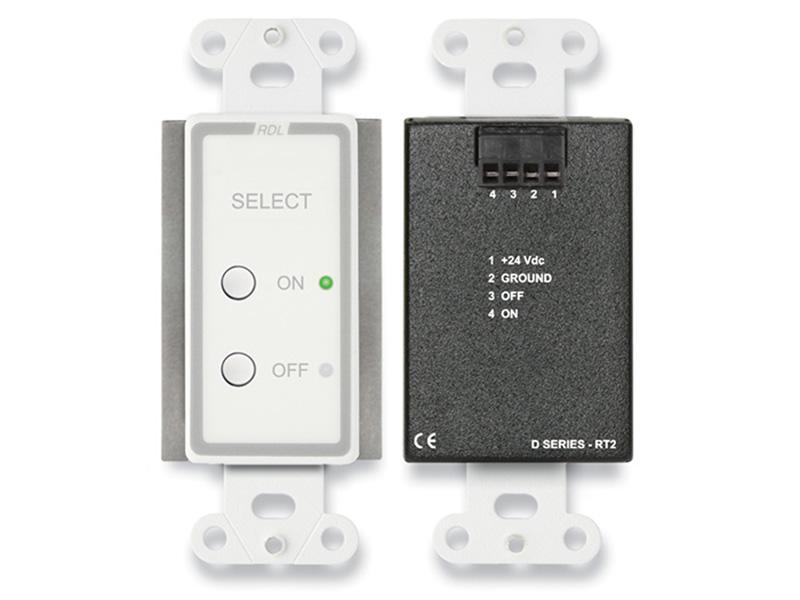
The D-RT2 is a compact remote control selector designed to provide simple, reliable remote power selection between ON and OFF modes. It uses two momentary pushbuttons on the front panel and adjacent LEDs to indicate the selected state. The unit defaults to OFF at initial power-up and toggles instantly when the opposite button is pressed.
Key features include dedicated single-button selection for ON and OFF, separate open-collector outputs for each mode, and LED status indicators for clear visual feedback. The front-panel LEDs show which mode is active and respond immediately to operator input. Wiring supports a single shielded pair for basic triggering or both outputs for more complex control schemes.
Technically, the D-RT2 requires ground-referenced 24 Vdc power and draws approximately 30 mA. Each open-collector output is rated to 25 mA maximum. The unit is specified to operate over an ambient range of 0° C to 55° C and mounts in a standard US electrical box for easy integration into typical AV installations.
Connectivity is handled via a detachable terminal block that provides power input and separate output terminals for ON and OFF control. Remote wiring can use 3-wire or 4-wire configurations and a single shielded pair is sufficient for many installations. The D-RT2 is compatible with common RDL switching and control devices used for audio and video source control.
Common applications include remote powering of audio sources through solid-state audio switches, triggering video transmitters or matrix inputs, and pairing with remote volume controls where space-limited wall-mounted controls are required. The device is appropriate for rack room control panels, equipment closets, and in-wall remote stations adjacent to user controls.
Installation is straightforward and installer-friendly – the D-RT2 installs in a standard US electrical box and connects with a detachable terminal block for quick field wiring. The front-panel appearance is professional and the mechanical design is suitable for repeated use in live environments. LEDs provide immediate confirmation of system state to both users and technicians.