




Description
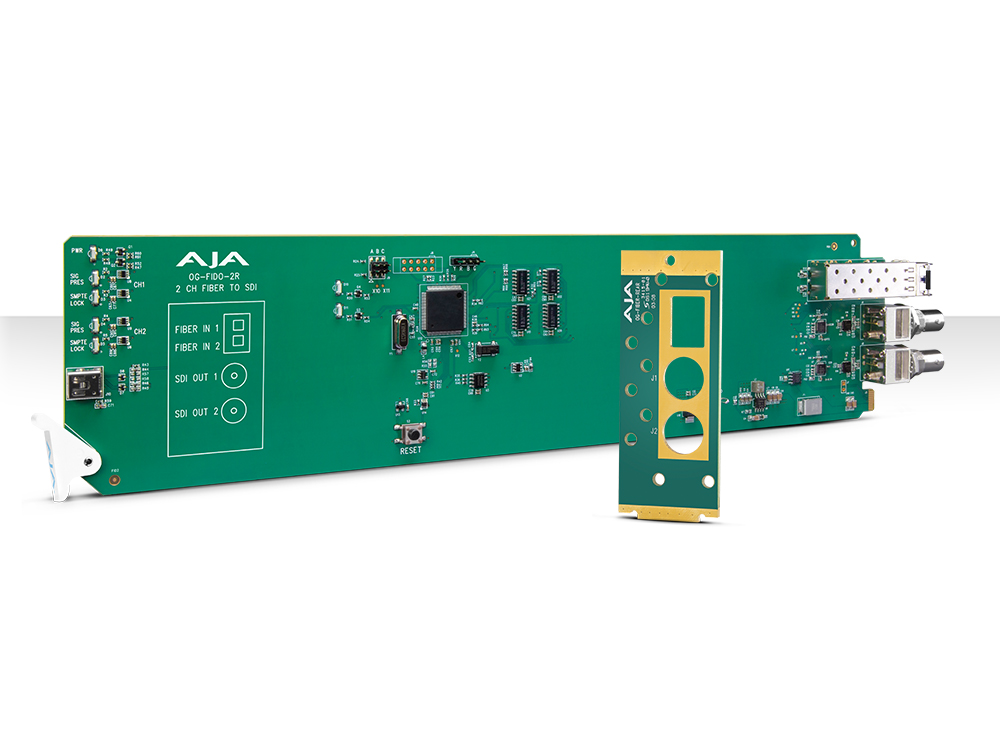
The OG-FiDO-2R-MM is a 2-channel multi-mode LC fiber to 3G-SDI receiver designed for openGear frame environments. It converts multi-mode fiber signals to two independent 3G-SDI outputs and supports cable runs up to 700 m on OM4 and 300 m on OM3. The module is format agnostic and supports video data rates from 150 Mbps up to 3 Gbps.
Key features include automatic detection and reclocking, input presence and SMPTE lock LEDs, and DashBoard monitoring support. The receiver accepts two multi-mode LC fiber inputs and provides two 3G-SDI BNC outputs. It supports auto-select for common SDI rates including 270 Mbps, 1.483 Gbps, 1.485 Gbps, 2.966 Gbps, and 2.970 Gbps.
Performance specifications include a nominal wavelength of 850 nm and a nominal power consumption of 2.5 watts. The fiber inputs are reclocked to manage input jitter and preserve signal integrity at SDI rates. The product is hot-swap capable and is compatible with high-density openGear 2RU frames to simplify rack deployments.
Connectivity covers two multi-mode LC fiber inputs and two 3G-SDI BNC outputs with fiber connectors mounted to the main card for reliability. DashBoard support is available for Windows, macOS and Linux, enabling remote control and monitoring over a network. The card is compatible with OG-X-FR, OG3 and DFR-8321 openGear frames and adheres to the openGear standard.
Typical applications include broadcast facility fiber links, OB truck I/O, live event signal distribution, and studio-to-transmitter links where ground loop elimination and long cable runs are required. The compact openGear form factor helps to maximize channel density in rack systems. The unit’s automatic reclocking and LED status indicators simplify fault detection and signal verification in operational environments.
Installation is straightforward in openGear frames and the card supports hot-swap exchange for minimal downtime. Low power consumption reduces rack thermal load and the robust fiber-to-SDI conversion provides reliable long-term performance. DashBoard integration allows centralized monitoring and configuration to streamline system management.