



Description
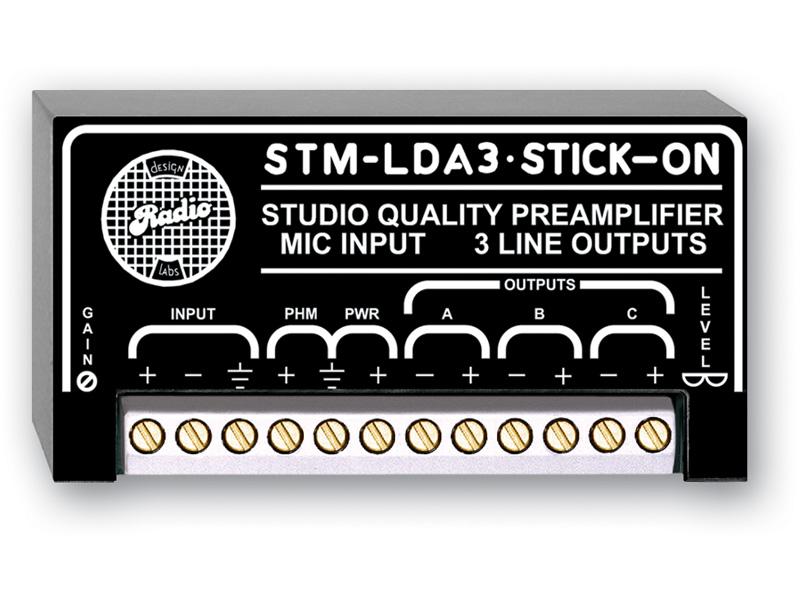
The STM-LDA3 is a studio-grade microphone preamplifier designed to convert low-level mic signals to professional line level. It provides three isolated balanced outputs to feed multiple destinations simultaneously. The unit accepts a wide range of microphone levels while preserving low-impedance microphone integrity.
Key features include discrete low-noise preamplifier circuitry, a multi-turn gain control, selectable filtered phantom power, and RDLs dual-LED VU metering for quick visual level setting. Gain can be adjusted across a wide 40 to 60 dB range using a 25-turn trimmer for precise level control. The dual-LED meter indicates -15 dB and overload conditions, enabling in-situ monitoring without external gear.
Performance specifications deliver a flat frequency response from 30 Hz to 20 kHz within 0.2 dB and very low distortion characteristics with THD+N and IMD below 0.1%. Equivalent input noise and overall noise figures are optimized for studio and broadcast use, supporting sensitive condenser and dynamic microphones. Headroom exceeds 20 dB above +4 dBu ensuring clean peaks are preserved.
Connectivity consists of a 1.2 kOhm balanced input and three +4 dBu balanced outputs rated at 150 Ohm each; outputs may be used balanced or unbalanced. Phantom power (24 V) is selectable via the PHM terminal to support condenser microphones. The module is compact and intended for modular mounting in distributed audio systems.
Typical applications include broadcast studios, voiceover booths, recording rooms, and distributed audio installations where multiple line-level feeds are required from a single microphone source. The STM-LDA3 is suitable for integrating with consoles, recorders, and distribution amplifiers while maintaining low noise and high fidelity. It is ideal where local level adjustment and visible metering are needed.
The STM-LDA3 is supplied in a compact form factor for easy placement and mounting in racks or cabinets using STICK-ON style installation. Setup is straightforward: connect the mic, set phantom if required, adjust the gain until the green LED indicates optimal level, and verify no red LED overloads. The construction and discrete circuitry provide reliable long-term operation in professional AV environments.